Saturday, April 27, 2013

Sanskrit literature


We had a little discussion on Sanskrit the other day, and I was asked to send in my notes to the group. Since I want to increase my blog readership, I decided to post my stuff! I will try my best not to say things most people already know.


The word Sanskrit refers to that, which has been ‘put together’.  (It happens to have the same meaning as the Greek syncretismos although the origin for the Greek word is attributed to the term for the Cretan Federation. Someone better challenge that etymology quick! To my laywoman’s way of thinking, the root word obviously comes from a proto Indo-European language.) We infer that Sanskrit is a language that has been crafted according to scientific principles, synthesized if you please, as opposed to Prakrit, which refers to language that evolves naturally (from Prakriti or nature). Sanskrit has always been a language of learning and refinement in India. The Prakrits were therefore not derivatives of Sanskrit (most probably the other way round), but simply the less hidebound easy-speak version of the same language. Prakrit and Sanskrit were mutually intelligible when our Indo-European ancestors first came to the sub-continent, but Prakrit being natural and not controlled by convention, evolved (but naturally!) giving rise to various dialects which ultimately transmogrified (Calvin, right?) into the various North Indian regional languages. The evolution was apparently slowest in the Gandharan region and fastest in Magadha. I suppose that means Kashmiri is closest to the old Prakrit, and therefore Sanskrit, while maybe Bhojpuri is the farthest. (Just hazarding baba. I know no Kashmiri or Bhojpuri). Sanskrit is regarded as the mother language of the North Indian languages, from Kashmiri to Bengali, much like Latin and the Romance languages – French, Italian, and Spanish.


Geographical spread of Indo European languages in the Old World. Indo-European is spoken by 3 billion native speakers. Grey is the non Indo-European world. Brown shows the Indo-Iranian branch of the family  that contains Sanskrit, Persian. Blue is the Italic (Romance) Family, Red is Germanic, Green is Balto-Slavic, Yellow is Greek.

Sanskrit is an Indo-European language. This means that it shares a common parent language with other languages of the Indo-European/Indo-Germanic family. Of course all of us have always been struck by the incredible similarities between the different languages of the family. Pater in Latin is Father in English is Pitareh in Sanskrit. Mater, Mother, Maatereh. Brother, Braathereh. Path-पथ, Go-गो, este- अस्‌ित, we found this game very exciting as children, until my dad pointed out that Fart and पाद probably have the same roots too. He felt we were getting carried away. Point noted but not taken. Excuse our Hindi. And English.


Sanskrit writing system–Originally, Sanskrit was intended to be transmitted orally. Megasthenes the Greek ambassador to Pataliputra mentions that the Indians have no writing system! So Chanakya literally composed the Arthashastra off the top of his head, and kept it inside his disciples' heads? Incredible. And we think the Chinese strange, sticking to their pictorial script for communication! In the peripatetic pre-paper and pre-printing era, it was easier to remember stuff than carry notes around I guess. I must say it is taking me much longer to write all this down. Definitely more than the 15 minutes I took to say it.


One uncharitable motivation for this oral tradition could have been that it ensured knowledge remained the preserve of a select few. There was no danger of it reaching the ‘masses’. (The horror of the masses remains the Indian intellectual’s greatest drawback. Just saying.) So, to decipher the language was not enough in those times, unless you got a teacher who imparted the know-how, orally. Apropos the Guru-Sishya Parampara. Remember how Karna and Ekalavya struggled without a teacher? Not like today, when mere paas Wikipedia hai!


Asokan edict in Brahmi

In fact scripts were first used for the Prakrits, by royal dynasties that obviously had to connect to their subjects. It was only later, that the body of Sanskrit literature, starting with the Vedas were redacted (meaning compiled, or reduced to writing), possibly in competitive response to a resurgent Prakrit writing tradition taking off, especially with the advent of Buddhism and Jainism that were not so bought into the casteist traditions of ancient India. The script adopted was usually the local Prakrit script of the scribe, from Kharoshti in the North West to Brahmi in the main subcontinent. (The point is not that no script existed, but that our intellectual forefathers sneered at the technology, preferring to rely on their memory. Statement thing, like not being on Facebook.) The Brahmi script had descendants – in the north, the Gupta, Sharada and Devnagari scripts came about in the 5th, 7th and 11th centuries of the Common Era; Grantham and Vattezhuththu came up between the 6th and 8th centuries in the South and spread to South East Asia through trade contacts, giving rise to the Burmese Mon script as well as the Khmer and Javanese scripts. Modern Thai comes from Khmer that comes from Vattezhuththu. Brahmi was the man. Or woman, likelier. (The Hiragana, phonetic system of Japanese writing is attributed to women; their men thought it was cooler to struggle with Kanji, which is the same as the Chinese logographic script.)

The Indus Valley script has not been deciphered yet. It could have been a precursor to Brahmi

I digress. Point is that Sanskrit did not pay much heed to the script used, although correct pronunciation was of paramount importance. In the nineteenth century Occidental Indologists found this lack of a uniform writing system an impediment to their research and promoted the use of the Nagari system. Hamare paas guru nahin par empire hai, they said.


Body of Sanskrit literature:


The non-reliance on a script has infused some unique features into Sanskrit literature. The earlier works are mostly metrical compositions with mnemonics interwoven to facilitate memorization. Sanskrit does not depend on syntax to convey meaning, and every word has a vast number of synonyms to facilitate composition into a metrical scheme (the number of synonyms frustrated foreign students like the 11th century scholar Al Beruni who wrote his ‘India’ for the Islamic world.)


Sanskrit literature may be seen as belonging to different eras starting with the Pre-Classical era or Vedic era. Reliance was solely on oral transmission and the writing was essentially religious, philosophic or scientific. Around the 5th or 6th century BCE, Panini standardized the grammar for Sanskrit. With the Gupta Empire ensuring peace and stability and prosperity, many works were written. The period between 300 BCE and 800 CE is called the Classical Sanskrit era. Then there is the Later period. Important works in more or less chronological order are as follows-


Rig Veda in Nagari - ca 19th cent. CE

Rig Veda – “Praise” - A collection of hymns in praise of the gods, mythological accounts for the origin of the world, prayers for prosperity etc., composed between 1700 BC and 1100 BC, redacted in 1000 BC and written down ca 400 CE.

Yajurveda: Composed between 1000BC and 600 BC it is the liturgical knowledge for conducting sacrifices, the mantras etc. Will have a lot of mathematics, like the formulae for constructing an altar etc.

Samveda- Melody is emphasized; these are hymns.

Atharva Veda- Dealt among other things, in magic, healing, warfare, philosophy etc. Seems secular to me.


The Vedas usually come in a set – the Samhita, that is the main collection of the metrical material itself, and the Brahmana, which is the commentary on the material, often in prose. Aranyakas and the early Upanishads are also seen as part of the Brahmanas, although of course, there are always works that straddle periods and classifications. The Upanishads or Vedanta are a set of philosophical treatises, which form the theoretical basis for Hinduism. They were composed over a wide swathe of time, from the Pre-Buddhist Period.

Sutra literature: Knowledge codified in metrical material, composed between 500 and100 BCE, concision being of importance. Includes the Vedangas consisting of manuals on astrology, metrics, domestic life etc. etc. Panini’s Ashtadhyayi is an example of the Vyakarana Sutra. Panini standardized Sanskrit grammar through his brilliant Ashtadhyayi that works through examples.


The Epics: – The Ramayana and the Mahabharata were composed and redacted between 600 BCE and 100 BCE. These are described as Itihasa, “It happened thus”, i.e. history.


Classical Sanskrit Literature: 300 BCE to 800 CE.


The main works of this era are –


Epic Poetry (Mahakavya): Western scholars refer to this as Court Poetry, since the hero is usually either godly or Kshatriya. Since everything was composed metrically, poetry, especially epic poetry was distinguished by certain identifying features, that I will not go into, as Ranjani has already done this. One important aspect was the technical virtuosity of the Mahakavis. They were not shy of showing off either. The great epic poems of this time are – Kalidasa’s ‘Kumarasambhava’ and ‘Raghuvamsa’, Bharavi’s ‘Kiratarjunaya’, Maagha’s ‘Shishupaala Vadha’, ‘Naishada-charita’, and ‘Bhattikavya’.


Lyric poetry (Khandakavya): ‘Meghadootam’ and ‘Ritusamharam’ by Kalidasa are superb examples. Bhartrihari’s ‘Shringarashataka’ is a contemplation on erotic sentiment.


Ethical poetry, as the name suggests, is  exclusively devoted to poetic aphorisms, (anyway found abundantly in Sanskrit literature) e.g. Bhartrihari’s ‘Nitishataka’ and ‘Vairagyashataka’. Yes it’s the same poet. He turned monk and then layman and back and fluctuated thus seven times between his house and the monastery. The substance of his work would have also been inconstant.


Fiction

Raja Ravi Varma's Shakuntala
Vasantasena

Drama: Kalidasa, Bana, Ashvaghosha, Shudraka were the big playwrights.  The most lauded are Kalidasa’s plays from ‘Malavikagnimitram’ to ‘Abhigyan Shakuntalam’. ‘Mrichchakatikam’ is one of the oldest plays and was made into the Hindi movie – Utsav. The Amar Chitra Katha Vasantasena, will give you the plot. I can't help giving a nod to Uncle Pai of Amar Chitra Katha (www.amarchitrakatha.com) who familiarised half a generation of Indian kids with their heritage and their culture.

 My personal favourite is Bana’s Swapnavasavadatta–the story of Vasavadatta and Udayana, which reads like an ancient times Bold and the Beautiful. Harsha’s Ratnavali, however, was like a sequel with different actors and poor continuity. Apparently Harsha’s works were lauded not as much for his hackneyed plots as for his brisk dialogue and knowledge of stagecraft. His Nagananda is seen as a brilliant play, however, departing from the stereotypical, and combining Buddhist philosophy with a Hindu Devi ex machina! 


Story Collections: Panchatantra (in prose with an admixture of verse), Hitopedesha (in prose with even more sententious verse), are the primary examples– These are stories with a lesson. These are actually seen as part of Niti-Shastra, (see down, under Shastra in Non Fiction).  The Vikram Vetal stories (Chandamama anyone?), The stories of Vikramaditya’s throne, and The Stories of the Parrot are other short prose collections.


Novel: The first Sanskrit novelist would be Bana Bhatta who wrote Kadambari in 6th-7th centuries CE. He was in Harsha's court and author of Swapnavasavadatta.


Non-Fiction 


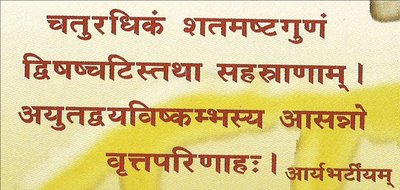
Scholarly treatises – Shastras, Tantras, Siddhanta and Jataka, on topics ranging from astronomy to mathematics to sexual congress. The Aryabhatiyam for example contains mathematical formulae in 33 verses! By the way Aryabhata left out the proofs in his Ganitapada, and it is thought that the teacher would have supplied those – see the unwillingness to let go? However from Bhaskara’s time in 600 CE, derivations were given in prose form! Tantras were mystical/scientific/ magical works and composed within the Hindu and Buddhist canon through the classical period.


Aryabhatta's sloka approximating π 
It transalates as follows and indicates the use of π : Add 4 to 100, multiply by 8, then add 62000, then divide by 20000. The result is "approximately" circumference of a circle of diameter 20000. 

The ‘Kamasutra’ by Vatsyayana would fall under the category of Kama-shastra. It is written in prose with poetic interpolations, and may have been composed between 400-200 BCE. It might have been collected into a compendium in 200 BCE. There are other works that fall under Kama-shastra.


Puranas: Our corpus of mythological and historical literature, written in verse form, dates between the 3rd and 10th century CE when the divergence of Shaivism and Vaishnavism emerged. Deals with creation of life, the various eras and genealogies.


Later Sanskrit literature – 800 CE to 1100 CE


A later, but important story collection is the Kathasaritasagara, written in verse, and adapted from the legendary Brihatkatha (lost work in Paisachi, a Prakrit dialect). Vikram Seth was only following in the footsteps of his ancestors.


Jayadeva’s Gita Govinda, describes the love story of Radha and Krishna in melodic and beautiful Sanskrit. Avadhuta Gita attributed to Dattatreya is a work of philosophy from this period that had a huge impact on the development of the Advaita philosophy.


There was a decline after the eleventh century coinciding with the rise of local dialects (the local Prakrits) that had so veered away from their original form that they were mutually unintelligible with Sanskrit and had a separate tradition of literature. But Sanskrit continued to be used for religious and philosophical literature and remained an inspiration for the vernacular literature of India.


Reference: Wikipedia zindabad. 

I also liked History of Sanskrit literature by Arthur Macdonnell http://www.gutenberg.org/files/41563/41563-h/41563-h.htm#contents

Thursday, April 11, 2013

American Pastoral by Philip Roth

When I read a book, my head swims with ideas and questions and a multiple other troubling matters. The more a book worries me, the less am I willing to ‘like’ it. (Like how I am uable to let go after my reread of Disgrace. I will have to either read ‘Scenes from Provincial Life’ or ‘Gone Girl’ before I am fit for society.) And that is exactly what has happened with American Pastoral, Philip Roth’s 1997 offering and part of his great American trilogy (with The Human Stain, and ‘I married a Communist’). I was hooked from Chapter 1, then set adrift, leaving me flailing for concrete ground. Hmmm, let me quit the high-flown semantics, quickly get to the meat of the story. We can analyze and argue later.

American Pastoral is narrated by Nathan Zuckerman, fictional writer, and Roth’s alter ego. Zuckerman is in his seventies here, a survivor of prostate surgery that has left him impotent and weak of bladder, a solitary pathetic figure nourished we presume, only by his writer’s curiosity and the satisfaction of regularly realizing his creative potential. Nathan runs into a man from his past, Seymour ‘The Swede’ Levov, who their entire Newark neighborhood once idolized, apparently because he was blonde, blue eyed, steep jawed and fantastic in sports. Believable enough; it is pointed out anyway that in those high school days of the forties, when Zuckerman’s ilk of second generation Jewish immigrants had just stepped onto the first rung in the ladder to assimilation, Swede Levov appeared to have arrived there already, showing them that it could be done. (One also infers that Levov’s lack of swagger imbued him with an aura: of the established one, of, should I say it, the well meaning, reticent Anglo Saxon at the top of the food chain!)

But on meeting him after all these years the star-struck Nathan is disappointed to find a bland, self-satisfied man, insisting on rubbing the lonely Zuckerman nose in cozy photographs and triumphant tales of family achievement. Zuckerman responds by consigning Levov to the boring platitude spouting multitude, one beneath the eagle eye of the author-narrator. However, a co-incidental meeting a few years later, makes Zuckerman realize how utterly wrong he has been in his reading, for the Swede, despite his obvious success in the diverse fields of sport and business and love, had been laid low by his beloved daughter’s destiny. Perhaps she had brought her fate upon herself, but it is no less horrifying to a parent for all that. That piques Zuckerman’s interest and he sets about dreaming up a ‘plausible’ version of what could have happened, a version that forms the substance of the book.

Philip Roth
How plausible Roth is, is borne out by the reception his book has received, for it cannot all be attributed to virtuosity, however much one likes the author’s gorgeous rants, or finds evocative the human interaction portrayed, or thinks interesting the descriptions of human endeavor – cattle farming, plastic surgery, glove making, feeding cake, take your pick. The American Pastoral has remained one of the most widely read and critically acclaimed American novels to date, and this will have to be because Roth writes the truth. But why am I not satisfied? Is it because in the best traditions of contemporary novelists he refuses to make one point (you already know I am thinking Disgrace here), but starts up a story abounding in any number of points, if only you picked them up? Is this the fate of the novel in the post analytic world where even evil has been teased into nothingness, where the author inevitably loses his direction? Yes, I have digressed here.

Back to the book. Just like the framing device of the novel is handled by Nathan Zuckerman, the body proper of American Pastoral is told from the bewildered perspective of Swede Levov, who while dealing with the aftermath of his daughter Meredith-Merry’s violent revolt, tries to understand what went wrong. In doing so he gives us nuggets to sift through the filter of our own experience, knowing as we do, the ultimate dénouement, (a brief history of Swede Levov’s life is contained in the “prologue”). Swede Levov goes back and forth in time, reveling in fond memories of an uncomplicated past, speculating on the reasons for his daughter’s breakdown - whether it was the lack of a religious foundation, or her being an only child, or her stuttering disability and perhaps their less than perfect parenting response to it, (but then again, who could claim perfect parenting strategies), or a very inappropriate kiss between Swede and a growing Merry (now this one is more worrisome). We get sucked into the game, as he anguishes. Is the Swede too smug, too unwilling to see a problem until it hits him on the head? Does he mirror the American experience? The Swede is constantly surprised by people around him – he does not worry that an intelligent, stuttering child of clearly glamorous parents could be miserable, thinking it enough that he finds her wonderful, he has no idea how important lack of appearance (of looks, class, and intellectual achievement) is to him and to his wife, he is not riled by the nasty remarks of the incorrigible Marcia Umanoff, most importantly he is not goaded by the violence coursing around him, so apparent in the bizarre events of the dinner he hosts towards the end of the book. 

We also wonder if the Swede’s moving away from his tribe (a Jewish identity), in the name of an assimilation that has not really happened, creates a vacuum in his child’s life that she tries to fill with her own individually created belief systems? Or is it only a case of crisis paralysis, for as the book progresses, Swede Levov seems unable to take any coherent action vis-à-vis his daughter. I could not help taking my musings further- so much land and so few people - you either farm the land or you squire it, or you move beyond the suburban. Is America creating little family islands brooding in provincial isolation, tinderboxes ready to explode anyway? It is amazing that one can get so carried away about the imaginary doings of imaginary characters. 

But still. Kuch khatakta hai. Ennomo neruderethey! And the more I think, the more I feel that it is the character of the Swede that does not sit right for me. He sounds wonderfully good childy in his John Appleseed fantasy, right up to when his daughter reaches adolescence. But is it possible that such a man would achieve all his dreams? In my limited experience, our gifts and talents give us a start in life, but what one makes of a business or a marriage requires character, and while self-delusion helps, it is never enough. The Swede could not have been such a babe in the woods, such an innocent if he came this far. And I do get it; there is an underside to him, steely or weak you decide, the side that does not see alternative scenarios, that walks away from a broken engagement, a broken marriage, the faith. I suppose he finds it more difficult to walk away from a broken child, but would such a character anguish like that? Who knows? I had to ask others. 

Tarun was like – Swede Levov realizes that he cannot accommodate his daughter in the life he has made for himself, and that is his tragedy. Alright. I went to the book discussion. 

Madelyn felt the book was pitch perfect in its portrayal of America. Having grown up in a New York neighborhood next door to many Jewish families, she could identify with the setting and that in itself, was exhilarating. Madelyn also found the development of the novel symptomatic of what she felt was happening in America, ‘the descent of the collective dream of the American Pastoral into the individual American berserk’. She appreciated also, how American history had been swept into the scope of this novel –World War II, the race riots, the Vietnam war, the weathermen, Angela Davis, the sexual revolution, the Watergate scandal. If Madelyn had to pick one inexplicable wrong move – by Levov/ Zuckerman/ Roth, it would be the kiss. She could not see how such deviance could so normally be woven into the story. My take is that the Swede gives himself away in more ways than one, through that incestuous kiss – in effect it is an admission that Merry’s stuttering is a terrible affliction that needs drastic recompense. I have to admit however, that the episode came across rather self consciously clever in a post Freudian way.  In the tradition of Woody Allen and Portnoy… 

I saw also in Roth’s writing, a delineation of the Jewish identity, how it explained many things to me, and how uncomfortable that made me. I did not need these sociological inputs about a people after the history lesson of Master and Margarita. Does reading great fiction make one an armchair ethnologist? Mamta asked how this story would have panned out in an Indian context- she felt an Indian middle class household would have never moved beyond Meredith, her story would have become theirs. Shivalik felt that the novel was really about America, the story of a nation that discovers itself veering off a blameless course to a happy ideal, as it gets blindsided by events. Possible. The sweep of the novel is American; why should there not be an allegorical significance?
 
Of course everyone wondered about Merry’s breakdown and the causes for that- the mother, the lax upbringing, an isolated life. It was interesting that I had read ‘Some Girls’ by Jillian Lauren just a week before starting American Pastoral.
 

'Some girls' is the memoir of a suburban New Jersey girl who rebelled against her Jewish middle class parents and ended up in the sex trade, ultimately landing in the harem of a Brunei prince. 
As airport reads go, it is superbly written, but what I took away, was that a kid from a perfectly boring-normal western background, brought up by well meaning reasonable parents could end up as the pet of a bored sultan. There are similarities between Merry and Jillian. Both of them felt disconnected at home perhaps, (Merry because of her insecurities, Jillian because she was adopted), both grew up in very well off Jewish households but in cosmopolitan neighborhoods; they probably felt alienated from their suburban peers. But more interesting was the difference between the real and fictional stories of a girl gone wrong. There was real violence in Jillian’s home. That key ingredient for someone to become unhinged - Roth hints at sexual abuse, but he is half hearted about it, would it have made sense instead, to have hinted at violence in the home?

I cannot end the review without registering a protest against the portrayal of a religion so moderate in its outlook as a kooky violent group, even from the warped perspective of a demented Meredith. Jains are vegetarians but scrupulously clean, but more importantly a basic tenet of their faith is ‘anekantavada’. Anekāntavāda encourages its adherents to consider the views and beliefs of their rivals and opposing parties. Proponents of anekāntavāda apply this principle to religion and philosophy, reminding themselves that any religion or philosophy—even Jainism—that clings too dogmatically to its own tenets, is committing an error based on its limited point of view. Roth could have surely picked another religion to project as fanatic. Maybe he was being ironical.

But the book makes you think. It is important and readable. Pick it up. 

Friday, February 22, 2013

The Master and Margarita, by Mikhail Bulgakov


I love Russian books. My introduction to adult literature was through a collection of short-stories by Gorky, a book I received as a prize in Middle School. I may not have understood all of it but I appreciated it.

I was also very much the product of the Cold War era. Non-aligned India leaned left, the Indian Air Force flew MiG-21s, my father spoke Russian, our family possessed Soviet memorabilia from his only trip abroad. And books from Russia were cheap. I grew up reading ‘And Quiet Flows the Don’.  As I read more I grew to love Lara and Aksinya and Levin and Ivan and Mitya and Grushenka. I loved the honest and fierce sensibility of the Russian writers, their brilliance that gave full play to drama but controlled it, in page after page devoted to the terrible search for an elusive truth and happiness.

And then I took up The Master and Margarita, Mikhail Bulgakov’s offering that has upended all my notions of Russian Literature. This is not a book that systematically plumbs the depths of human experience. Instead, it calls to mind flying fish leaping to evade the predators lurking below. If you will, dolphins coming up for air. If there is a tinge of hysteria in this experiment in magical realism, that, I suppose accounts for the realism. 


Mikhail Bulgakov
This book was written in secret, in Russia between 1929 and 1940, at the time of the Great Purge, when repression, deportations and sudden disappearances were the order of the day, when writers kept packed suitcases in the hallway, preparing for the proverbial midnight knock on the door. Bulgakov came from a family of priests and had served in the White Army; moreover he was a playwright who in the best Russian tradition wished to portray reality as he understood it, his understanding often at odds with that of a totalitarian regime. He was a prime candidate for the lethal moniker ‘Enemy of the state’. Writing a subversive novel like the Master and Margarita was a risk, but it might have also been its author’s redemption. Indeed Mikhail Bulgakov had no immediate hopes of its publication as he raced to finish this masterpiece before he died.


'The Master and Margarita' opens one hot spring evening in Moscow, with the arrival of supernatural forces in the form of a Professor Woland and his assistants. Professor Woland strikes up conversation with two men – a literary critic and a poet. To elucidate his point, he goes on to narrate a fascinating account of the events surrounding the Crucifixion. He also predicts precisely the gruesome death of the critic listening to his story. What follows is mayhem, a series of inexplicable and magical events that rock Moscow. The poet who has witnessed the death of his friend and the supernatural abilities of this Professor (of Black Magic) finds himself in a lunatic asylum. There he meets the Master, a man who has suffered a nervous breakdown following the rejection of his life’s work, an account of the life of Pontius Pilate. The Master talks of  Margarita, the love of his life. Meanwhile Margarita, in order to rehabilitate the Master makes a Faustian bargain with the devil, Professor Woland that is, for he has been identified as such by common agreement. 

By the end of the book, the Master and Margarita achieve a semblance of closure as have the various Muscovites traumatised by the antics of the Devil’s coterie. So have Pontius Pilate, and significantly, a pathetic sinner, suffering for eternity for having suffocated her child.

Personally I found the Moscow narrative tedious (alright, it was painful in the extreme; it reminded me that there is a certain repetitive quality to Russian writing, and while it achieves closure for the writer, is seldom enjoyed by the reader. A case in point is Gorky’s story, character study really, of his ‘Travelling Companion’). However, I believe ‘The Master and Margarita’ makes an instant connection with people of that time and place, sending a jolt of pleasurable recognition of the travails they experienced. Bulgakov’s flights of fantasy - the witch’s Sabbath and Lucifer’s ball to give two examples, were too over the top for me. But I was in thrall to his story of Pontius Pilate, of a man who knew where justice lay but did not see it done, and suffered for it. With a few strokes of the pen – the overpowering scent of rose oil, the scorching sun, a splitting headache, a wrinkled olive tree, Bulgakov recreates first century Judea. It is a literary tour de force and a testament to Bulgakov’s genius. After I finished the book, I immediately reread the Pilate chapters, and it was every bit as enjoyable the second time around. I think I also began to understand the appeal of Christianity in Europe.

I have always wondered about the hold of an essentially pacifist religion over a basically  forceful race. It could be that people choose the religion that they need, just as the undoubtedly aggressive Mongols of Chengezed heritage gravitated to a religion that means Submission. But I wonder now, if European Christendom did not identify with Pilate. Any religion founded on martyrdom must give rise to a protective and assertive-aggressive outlook in its followers. So it should be with Sikhism and so it is with Shia-Islam. Come to think of it, modern day Zionism. A sense of ‘never again’, perhaps.

The dog and Yudhishthira ascending to heaven (ignore Bhima)
So, I called my mother with my little epiphany. She surprisingly heard me out, and then surprised me further by asserting that Bulgakov must have been exposed to Hinduism! The basis for her assertion is in his play White Guard. A character, Zhilin, asks God why he welcomes Bolsheviks into heaven, when they do not even believe in him. God replies that it is all the same to him whether the soldiers believe in him or not. He says, “Zhilin…you have to understand, that for me you are all identical – killed in the field of battle.” This is too similar to the story of King Yudhishtira of the Hindu epic Mahabharata, who dismayed to see his mortal enemies, the ‘unrighteous’ Kauravas in heaven, asks Zhilin’s question. He too is told that the Kauravas have died in battle and have a right to heaven.

Then there is the imagery of Pilate’s dreams. In his dreams Pontius Pilate argues happily with Christ  as they ascend a sort of moonlit celestial stairway, followed by Pilate’s faithful dog (all men are bad says Pilate, no they are good says Christ, but they agree that cowardice is the worst of all human failings). This picture too, recalls Yudhishtira who refused to ascend to the heavens without his faithful dog.

 Rushdie: Bulgakov was an influence
Mamta felt that all characters were various aspects of the writer. Shivalik found it impossible to pigeonhole the book, although Rushdie’s books, in particular the Satanic Verses are comparable. In some sense all characters are reflections of its author, but to my mind, the Master and Margarita represent Mikhail Bulgakov. The Master, the impractical artist who wishes only to live through his work and is crushed by criticism and intimidation, is as much Bulgakov as is Margarita, the ambitious pragmatist, compassionate and vengeful and weighed down by the bargain she has struck with the forces of ‘evil’ to rescue the Master. (Bulgakov owed his survival to the patronage of Stalin, who had liked a play of his, and responded to an open letter with a personal telephone call- leading some to surmise that Professor Woland could even represent Stalin).

The Master offers blessed release to his hero, Pontius Pilate whose courage failed him once. The parallels between the Master, Pilate and Bulgakov are striking. Margarita similarly redeems a woman condemned to be reminded eternally of her act of suffocating her child, again an arresting analogy for the pain suffered by an artist who smothers her own creation. Does suffering and redemption lie within the same person?

If there was something that bothered me it was the strain of revenge seeking, as a balm for one’s torments. Pilate executes Judas in the book and vows eternal enmity with the Jewish Sanhedrin, Margarita trashes the apartment of the literary critic who ruined the Master. There is the unmistakable odour of anti-Semitism, although Bulgakov is objective and precise in his depictions. I have to remind myself that he died before the atrocities of the Jewish Holocaust came to light.

The book is a cry from the soul of an artist forced to acknowledge his powerlessness. A true artist cannot be a pragmatist but when he is beset by forces from without, his art has to twist and swerve into different modes of expression if it is to remain true. So it is with The Master and Margarita. A tough read, beautiful in parts, and guaranteed to leave you thinking for days.

Wednesday, February 6, 2013

Oh Delhi!


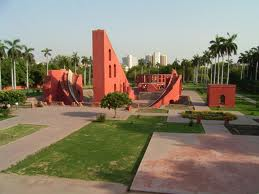
The Jantar Mantar is an architectural observatory
Delhi versus Bombay arguments happen all the time in India, something that adds spice to a first date or an after dinner conversation, not unlike Hong Kong-Singapore showdowns or the NYC-LA face-offs. If Delhi is loud and all brag, Bombay is mercenary and all hustle. If Mumbai claims the crown for business and cinema, Dilli has her four thousand year history to tote. If a Mumbaikar moans over the small town mentality of the Delhiite, Dilliwalas scoff at the miserable Bombay existence. However, one subject brooks no discussion. Delhi is a grim place for women. It is universally agreed that it resembles a frontier town in the Wild West, where everything a woman says or does, including how she carries herself, can become a serious matter, with consequences ranging from the merely disturbing to the truly horrific. And women like us, old timers who came of age in our nation’s capital, have our stock of war stories, yarns that we dourly trade, woman to woman, pretending to more bravery than we felt, reliving the danger and inflating the risks we took… sometimes even sharing the outrage and the shame. 
Jantar Mantar at Delhi

I was sixteen when one Delhi winter morning, my friends talked me into going to the Jantar Mantar. On a vague impulse, we raced up a structure in the architectural observatory. The lack of a parapet brought on the usual tingling in my palms and feet, but it was on the way down that I took in the steep and narrow steps; I was seized by an attack of vertigo. Resting my slippery left hand on the wall, I sat my way down, taking care not to look at the amazed faces of my friends, or the sheer drop on the right. I had been so busy chalking the route back home that I had forgotten my immediate problem of heights.

When I see the crowds on television, protesting at Jantar Mantar in the aftermath of the unbearable atrocity of 16th December 2012, I am reminded again of how I was always afraid to soar high or venture far in Delhi. Every independent outing during my girl hood was attended by a detailed retreat strategy.

So getting back from Jantar Mantar—we would get off at the main INA Colony bus stop, where one of my mates, lucky girl, lived. I had choices. I could take a bus home, with the usual problem of harassment on the bus and the bus stop. I hated buses, even before I was groped, which was before I knew a prepubescent school child could be squeezed by a clean cut Zaheer Abbas look-alike, and that a busload of men, old and young, could find this funny. I did two things that day – I cut the side seams of my kurta higher, so they would be baggier, and I decided I would not board a Delhi bus alone. But we were not rich, car rides were out of question.


Interestingly the Cambodians see themselves as descended from an Indian prince and a Naga princess
Primal genocide - Khandava Massacre
I could walk then. If I walked, I could take the shortcut­­—past a Government boys’ school, over a sewage canal with pigs rooting in refuse, and through a dense neighbourhood arranged around a lovely tomb that I never thought of exploring. The deserted and noxious bridge was the only part of the way that was not nerve wracking. I invariably took the long walk home, skirting the market and the residential colonies, hugging the main roads, ignoring likewise the parallel feeder lanes on my left, and the whizzing traffic to my right; disregarding my mother’s maxim that safety lay in crowds. Where the likelihood of harassment is high, you seek solitude and pray.  I got lucky, for in my sporadic outings over four years, I did not meet too many people on this route. Two, to be precise and on both occasions they justified my trust in the misogyny of the Delhi male, though nothing terrible happened, nothing worse than what I was used to, all par for the course. One boy muttered an obscenity as I passed him, (I was wounded by the “fat” he prefixed to it). He tried to follow me but backed off when I shouted at him. The other time, I was punched hard in my chest by a passing cyclist. I doubled over in pain and shock. I had not expected bicycles on Ring Road and that kind of anonymous hatred was a bit much, but I was not too affected, it was my last week in Delhi, my cursed capital city that has been burnt and sacked and rebuilt so many times. 
Delhi massacres - Timur, Nadir Shah 

Delhi has folded into her lap the terror of the mythical Nagas of the Mahabharata, whose forest homes were gutted to make way for Indraprastha, her first and prehistoric avatar. Delhi has soaked up the blood of the one hundred thousand men beheaded by Timor the Lame outside her gates on December 16, 1398—yes it was the same date. In the course of six hours in March 1739, she embraced the twenty thousand men, women and children who fell to Nadir Shah’s Persian army. And she watched mutely in September 1857, in these, our modern, enlightened, times, as her lofty princes of Mughal blood were stripped and strung up on the roadside like so many ruffians in the dark ages. I had had enough of Delhi and her bloody history. I moved on to Chennai and Kolkata to study, then to Mumbai to find work. 

I have since trekked in the Sahyadri Ghats of Maharashtra and the Himalayan foothills of Meghalaya, I have sung in college bands and worked nights as an Investment Banker; I have taken buses, trains, cabs and auto rickshaws, and walked, in the wee hours of the morning in all these parts of India; I have travelled the length and breadth of my country. Six months ago, I got onto the road in Mumbai to stand before a public bus coming down at my taxi, so we could get the leeway needed to make the impossible about turn my young cabbie had embarked on before he froze mid road ( ‘I hate this’, he had cried. My heart went out to him and we chatted the rest of the way. He was from Gorakhpur, looked no more than seventeen. I am not sure if I would reach out like that again.)

 I hope I am not a coward. But I have not gone back to Delhi.


I passed Darya Khan's tomb everyday, never thinking to explore it
Delhi chat
I have not been to Delhi for fifteen years, though I miss her so, her brash energy and her old history, her emporia of bargains and her wistful weather beaten beauty. But I dare not ride a bus in the city I grew up in, or take a walk to enjoy the best street side food in the country, or go off to explore any of the innumerable ruins redolent with untold stories that dot the city, not without an escort and the trappings of privilege–chauffeur driven cars, chalked out itineraries, experienced guides.

And so I salute the Delhi girls who by choice or circumstance use public transport for their daily commute. Some are born courageous, some have courage thrust on them, but they are all brave Delhi women.

Sunday, February 3, 2013

Beautiful Ruins by Jess Walter


Jess Walter’s latest offering is an irresistible potpourri of Hollywood folklore, reality television, love and ambition, and most of all the overweening need to break out and matter in today’s world. The story moves across a fascinating number of places and times including but not limited to, the Italian Riviera of the sixties, the Hollywood of then and now, small town America, even the Fringe Festival of Edinburgh.  Through it all the author shows an awesome command of form and content, and a phenomenal control of his medium, letting out the suspense to build it up again, maintaining  all the while, a light humorous touch that keeps us turning the pages happily. And he has a message too – do what makes you happy and chill. His panacea for the problem of plenty. (Refer my review of Franzen’s Freedom – “the problem of plenty”).
What’s not to like?


Richard Burton and Liz Taylor in Cleopatra
It is 1962 and Pasquale Tursi of the lovely blue eyes has just returned to his tiny fishing village on the Italian coast, determined to make the family business - a rundown, “Hotel Adequate View”- into a world class tourist destination. To this end, he is busy building a beach, and designing a cantilevered tennis court atop the cliffs, something he imagines would immediately impress visitors coming by boat – incidentally the only way to reach this out of the way hamlet. What happens is that a Hollywood starlet descends on his hotel and Pasquale reacts, as if in a dream’s opposite, a burst of clarity after a lifetime of sleep. The actress has been sent from the sets of Cleopatra, (yup of Liz Taylor and Dick Burton fame), and believes she is dying. Pasquale finds himself enmeshed in her affairs.

Cut to the present, where Claire Silver, Chief Developmental Assistant to legendary film producer Michael Deane is failing in her own assessment of how she is living her life. Her job’s all assisting, no developing, and she’s nobody’s chief. In the course of her work they have hit pay dirt with reality television – and her hopes for making meaningful cinema shrink by the day as she hears out one outlandish pitch after another –

Claire saw why people worked so hard to not get things made - because once you did one thing, that became your thing.

She has a boyfriend addicted to online porn, strip clubs and texting unpunctuated questions - 'milk', 'cereal', 'what up', to quote a few; she is heartily ashamed of him. Claire is onto her last pitch for the week, when who should come looking for Michael Deane, but Pasquale from all those years back. It is lucky that the man who is making the pitch at that time knows good enough Italian to translate for Mr. Pasquale Tursi, who is on a quest for Dee Moray, the sick starlet who came to his Hotel in 1962. Tursi’s only link to Dee, the seventy-two-year old Michael Deane who was then in the publicity department for Cleopatra, and who through an impossible to trace sequence of facials, spa treatments, mud baths, cosmetic procedures, lifts and staples, collagen implants, outpatient touch ups, tannings, Botox injections, cyst and growth removals and stem cell injections has acquired the face of a nine-year-old Filipina, and is as hard-bitten and unconscionable a Movie-Moghul character as was ever drawn, surprisingly agrees to help. Lo, the story has acquired a life of its own.

Jess Walter
What follows is an account of what happened in Italy then, the search for Dee  now, interspersed by an interesting set of narratives starring each of the myriad characters populating the book. And reading it is great fun. We are in the pages of a master craftsman. I for one will have to read his most successful book “The Financial Lives of Poets”.
It appears that Mr. Walter disapproves of the ‘extreme anguishing’ that most people seem prone to, especially those with ambitions to be creative. He also wishes to debunk the motto he clearly thinks might be a malaise affecting the populace – Act as if ye have faith and it shall be given to you. He favors doing the right thing, and keeping the wanting in check so it does not take you away from doing the right thing. So Alvis Bender puts his unwritten novel away in order to get on with living (it hits him that, indeed, all that he wanted to say has been said in his first chapter). Pat Bender makes his peace with his relative anonymity, and Claire does what she feels is “right” for her.

If only it were that simple.
Such clear problems and solutions do not make for life, it makes for fiction. Good fiction in the hands of a humorist par excellence, a superb entertainer and master craftsman, who makes you read even as you shake your head. There is no soul searching, no epiphany, or discovered truth as opposed to received truisms. But would that not be the preserve of an artist, the tortured genius who struggles with her medium and extends it, expresses her innermost anxieties, while fighting her demons? (Virginia Woolf comes to mind, maybe because of my feminist 'sheing' of everything in the last sentence.) If that’s the sort of thing you enjoy - I mean art, not feminism - then wait for my next review. “Master and Margarita” by Mikhail Bulgakov, set in Stalinist Russia, written during Stalinist Russia, when wanting and doing the right thing was all set on its head.

Monday, January 21, 2013

‘The Mountains Came to Mohammad’: My entry for the Get Published contest


The story is set in Hong Kong, where Raghav and Kareena employ an Afghan driver, Mohammad Khan. Mohammad Khan wears a flowing beard, refuses to look women in the eye and prays five times a day. A Nepali maid looks after the two children in the family. Her name is Parbati and she is from Siliguri in India. She is withdrawn, but emanates a calm strength. Parbati and Mohammad have different backgrounds, different beliefs, follow different faiths. Yet something unites them – their love for the young children of the family, and a yearning for the mountain homes they have left behind. As the days pass, they realize that nobody understands them better than the other, but do they have a future?

This story is real because stories like this take place everyday.

The story will unfold through normal events that take place in any family and will include descriptions of the underrated natural beauty of Hong Kong. We will delve into the back-stories of the characters and how that informs the decisions they take. An excerpt from the story-

He drove into the petrol pump, and while getting out, turned back to explain, rather needlessly, “There is no petrol, madam.”

“Why does he look sideways when he talks to me? It’s so creepy!” Kareena had the quick and breathless British diction of a certain kind of Hong Konger. “Like he’s got no eyes, know what I mean? But Raghav went on about how he is being respectful and how their people have ‘tehzeeb’ and all that...”

“Yes it’s a pity,” her friend agreed. “If he ditched the skull cap and shaved his beard, he’d be quite dishy, don’t you think?”

“Puh-leez!” squeaked Kareena, “He’s not old or anything, I grant you; his ID says he’s twenty seven. But his eyes!”

Parbati, sitting in front, was too surprised for words. Maybe it was the beard or the Pathani Suits, or his gentle demeanour; she had thought of Mohammad Khan as an older man. She looked at him as he walked back after paying the petrol bill. He wore a loose shirt over track pants she realized, not a Pathani suit, and he was tall and strapping under those clothes. He got in and turned around as always. “Chocolate for Rishi Baba,” he said, to a chorus of protests. “Mohammad, you cannot give Rishi sweets. I am serious.” Kareena was worked up. “Parbati this is for you too. Don’t let him give any sweets to the children, do you hear me?” Parbati involuntarily looked at Mohammad just as he turned to her, his eyes full of humour and mischief. He had forgotten to look away. Parbati’s breath caught. He had the most beautiful brown eyes, fringed by the darkest thickest lashes she had seen. His eyes…